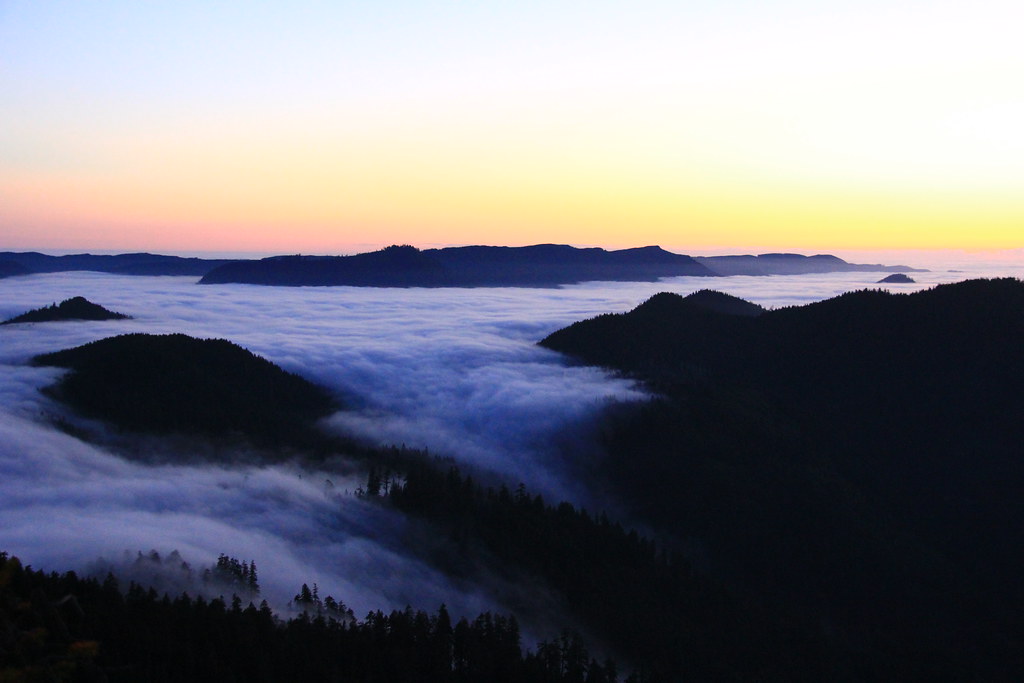
The fog came in fast on the Rhinogydd above Cwm Bychan, the way it does in north Wales in May, with the wind dropping out and the visibility closing from a quarter mile to twenty feet in under ten minutes.
Astrid Pereira had stopped at a small cairn to take a compass bearing. When she looked up, the next cairn was gone.
She had walked the ridge between Rhinog Fawr and Rhinog Fach four times before, once in worse weather than this. She knew the bearing. She knew the distance. She did not move.
What she did was sit on her pack and listen.
Hearing is the navigation sense most walkers forget they have. Sight gets the credit. Touch gets the compass. But in cloud, on a featureless plateau, or in dense forest, the ear can locate a stream, a road, a sea, or a single bell-cow paddock with a precision that does not depend on what the eye can or cannot find.
The British outdoor education tradition has a name for this. Aural handrailing. It is not in most navigation textbooks. It is taught one-to-one by instructors who have used it on hills like the Carneddau and the Cairngorms and trust it more than they will say in print.
Pereira teaches it to her students at a centre in Snowdonia, usually on the third day of a five-day course, after they have learned to trust the compass and before they learn to trust themselves without one. She introduces it in good weather first, blindfolded, with a partner watching for hazards.
The exercise is simple. Stand in an open field within hearing range of a road, a stream, and a building of some kind. Close your eyes. Point at each sound source in turn. Try to estimate distance.
Most people, on the first attempt, are accurate to within thirty degrees of bearing and wildly wrong about distance. By the third attempt they are within ten degrees and have begun to notice the difference between a stream they can hear over their left shoulder at four hundred metres and one they can hear at one hundred and fifty.
What changed for Pereira on the Rhinogydd was that she had a known sound source. The Afon Crawcwellt drops off the eastern flank of the ridge in a series of small falls. In dry weather it is barely audible. In May, after a wet spring, it runs hard.
Sitting on her pack in the cloud, she could hear it. Not loudly. Not even continuously. But in the lulls between gusts, it was there, off to her left and below, somewhere around eleven o'clock from her line of travel.
She knew the topo. The stream ran roughly parallel to the ridge for almost two kilometres before bending east toward Trawsfynydd. If she kept it on her left and at roughly the same audible distance, she would stay on the ridge.
It is not pure navigation. The compass was still in her hand. The map was still in the case round her neck. The stream was a confirming reference, not a substitute for the bearing.
But it gave her something the compass could not, which was a sense of place that updated continuously without her having to stop and check.
Pereira has used the same technique in other terrain. Once, in fog on the high moor above Ystradfellte, she navigated by the distant rumble of the A4059 for a full hour. Once, on Skye, she used the boom of the sea against the cliffs of Sgurr Alasdair.
Each sound has its character. Water moving over rock is a wide-band hiss with a low component that carries. Roads are a sustained drone that varies with vehicle pulses. Coastal surf is a rhythmic low boom you feel in the sternum before you consciously hear it. Wind in conifers is different from wind in beech, which is different from wind on bare grass.
A trained ear can also pick out absence. The hush between gusts is not silence. It has its own shape, made of small biotic noise — meadow pipits, distant sheep, the click of a stonechat — and the absence of one of those textures can mean a change in habitat, which usually means a change in terrain.
Pereira does not pretend this is a primary skill. The compass remains the instrument. The map remains the document. But on a featureless plateau in cloud, when you have been walking for two hours and the ground has stopped giving the eye anything to fix on, the ear can be the difference between confident progress and a long, slow stop.
She made the col that afternoon in just under forty minutes from the cairn. The cloud lifted briefly as she dropped onto the saddle, enough to see the next cairn ahead and the lake at the head of Cwm Nantcol beyond.
She did not turn around to look at the ridge behind her. There was nothing to see. There rarely is.
Filed under