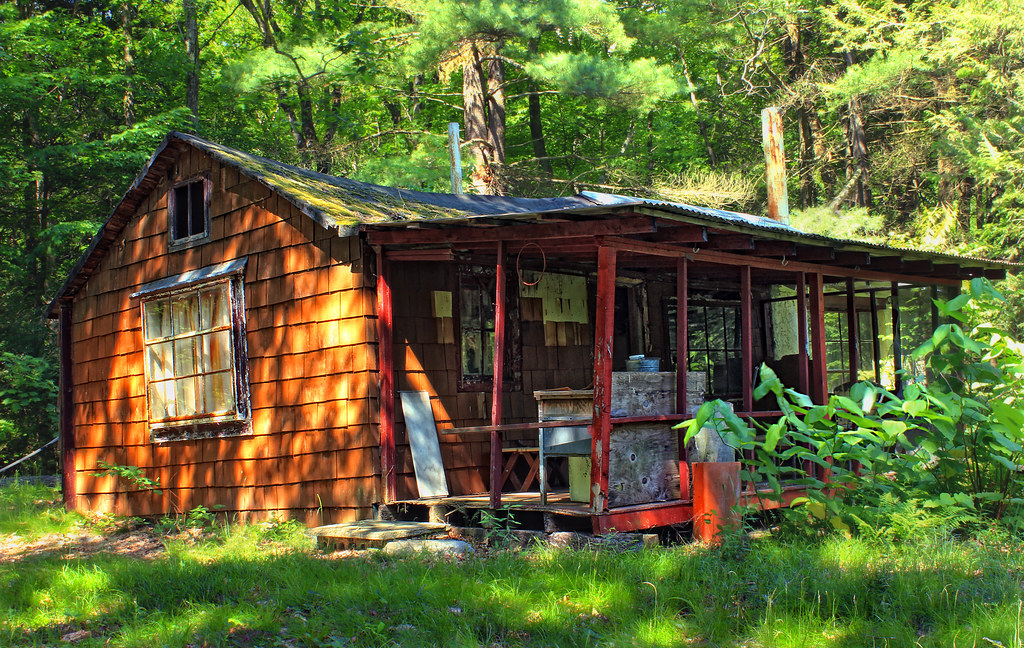
The Greenfly Ranger Station was built in the summer of 1937 by a Civilian Conservation Corps crew working out of a camp at Wishon Reservoir, on the western slope of the Sierra Nevada. It is a one-room log cabin with a stone chimney, a galvanised iron roof, and a small porch facing east. The USFS withdrew official patrols from the station in 1971.
The cabin sits at approximately twenty-two hundred metres in the Sierra National Forest, about nine kilometres north-east of Courtright Reservoir. It is not marked on any current public map. The trail to it is not on any USFS trail inventory issued after 1968. The path is, technically, abandoned.
A retired district ranger named Hal Forrester walks to Greenfly once a year, in late May or early June, when the snow has cleared from the south-facing approach but the higher ridges are still white. He has walked there every year since he retired in 2009. He is seventy-four.
Forrester worked at the High Sierra district station from 1972 until 2009. He was, for most of those years, the only ranger who knew exactly where Greenfly was. He has shown the route to three other people in his life: his daughter, his son-in-law, and an archivist at the USFS regional office in Vallejo who asked for the location for the historic-structures inventory in 1998.
He does not publish the route. He is asked, occasionally, by historians or by people writing about CCC architecture. He answers their letters but he does not give coordinates.
His reason is simple. The cabin has not been vandalised in eighty-nine years. The interior is largely intact. There is a 1937 Hoosier kitchen cabinet, a small woodstove of the same era, a writing desk built by a CCC carpenter named Olaf Ranstad. There is, on the desk, a logbook in which every visitor since 1949 has signed their name. The logbook contains, at this writing, six hundred and twelve entries.
Forrester believes that if the route were posted on a website, the logbook would be stolen within two years and the cabin within five. He may be right.
In late May 2026, Forrester invited this magazine to walk with him, on the condition that the route not be published. The condition was accepted.
He drove from his home in Shaver Lake at four in the morning. He parked at a small turnout on a Forest Service road whose number he asked not be printed. He began walking at first light.
The first three kilometres follow a former logging spur that was bulldozed in 1948 and has not been graded since. It is, now, a path two boot-widths wide. White fir and incense cedar have grown up on either side. In several places fallen trees lie across the path, and Forrester walks around them by routes he has worn over fifty years of visits.
At three kilometres the logging spur ends in a small clearing that was once a turnaround. Here the actual trail to Greenfly begins. It is not marked. Forrester finds the start by reference to a particular sugar pine which has a horizontal scar on its trunk at about chest height, made, he believes, by a CCC worker with a hatchet in 1937.
From the sugar pine the trail climbs a long, easy grade through second-growth pine for about five kilometres. The grade was laid out by a CCC engineer named Lloyd Beaumont and is, Forrester says, the most beautifully graded trail he has ever walked. It never exceeds eight percent. It traverses every contour the slope offers.
After the long grade the trail crosses a small stream on a footbridge of two cedar logs that Beaumont's crew placed in October 1937. Forrester believes the logs are the originals. He has checked the bark scars against a 1937 photograph held in the Vallejo archive.
Half a kilometre past the bridge the trail enters a flat shelf of about a hectare, sheltered to the north by a granite outcrop. The cabin sits in the centre of the shelf, facing east, exactly where Beaumont's crew built it. There is a meadow in front, with shooting star and corn lily in May.
Forrester unlocks the padlock. He installed it in 2014 after a single instance of a hunter sheltering inside during a storm and leaving the door open behind him. The lock is brass, made by the Wilson Bohannan company in Marion, Ohio.
Inside, the cabin smells of cedar and woodsmoke and dust. The light through the east-facing window is the long flat morning light of a high meadow. Forrester opens the woodstove, checks the flue, and lights a small fire from kindling he keeps in a bin by the stove.
He spends three hours at the cabin. He sweeps the floor. He empties the rodent traps. He checks the roof. He signs the logbook. He reads the previous entries. There were two visitors in 2025: Forrester himself in June, and a USFS historian who came up with him in September.
He boils water for coffee on the woodstove. He sits on the porch with a mug and looks east across the meadow. He says he thinks about Beaumont and Ranstad and the other CCC men who built the cabin, most of them younger than twenty, most of them now dead. He says he thinks about what it is to maintain something that nobody asked him to maintain.
He locks the door at one o'clock. He walks back to the truck. He is home in Shaver Lake by dark.
He will come again next May. He hopes the cabin will outlive him. He suspects that, with reasonable luck and continued anonymity, it will.